Learn›Arithmetic ReasoningAR›Shared work
Shared work
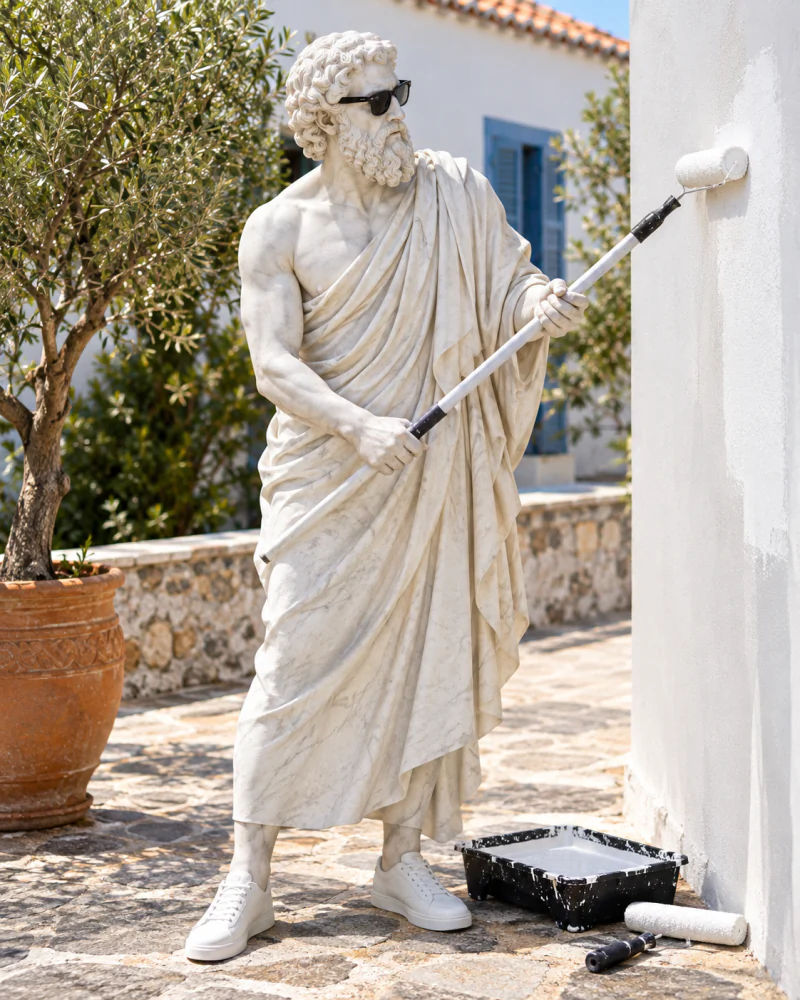
Two painters, three pumps, a faucet and a drain: “working together” problems look tricky because adding the times feels natural and is always wrong. Add the rates instead, and every one of them becomes the same short calculation.
Add rates, not times
Pat can paint a room alone in 3 hours, so each hour Pat paints 1/3 of it. Lou needs 4 hours, so Lou paints 1/4 of the room each hour. Those amounts per hour are rates, and rates can be added: working together, they paint 1/3 + 1/4 = 7/12 of the room every hour.
Together is always faster than the fastest one alone
If your answer for “working together” is longer than the faster worker’s time, something is wrong. Adding the times (3 + 4 = 7 hours) or averaging them (3.5 hours) gives exactly that kind of impossible answer.
How to solve them
-
1
Turn each time into a rate: 1 ÷ time
A job that takes 5 hours is done at a rate of 1/5 of the job per hour. Write every worker, pipe or machine as a rate before you do anything else.
A time shorter than an hour works the same way. 40 minutes is 2/3 of an hour, so in one hour the worker does the job 1.5 times: 1 ÷ 2/3 = 1 × 3/2 = 1.5. Dividing by a fraction means multiplying by its flip.
Next step: TogetherAlone in 5 hoursRate per hour
1/5 of the job
Alone in 8 hoursRate per hour
1/8 of the job
Alone in 40 minutesRate per hour (40 min = 2/3 hour)
1 ÷ 2/3 = 1 × 3/2 = 1.5 jobs
-
2
Working together: add the rates, then flip
Add the rates to get the combined rate. The time is that rate flipped upside down: if together they do 7/12 of the job per hour, the whole job takes 12/7 hours.
1/a + 1/b = 1/T
Here a and b are each worker’s time alone, and T is the time when they work together.
Next step: Two-worker shortcutExamplePat paints a room in 3 hours, Lou in 4 hours. How long together?
- Rates: 1/3 and 1/4 of the room per hour.
- 1/3 + 1/4 = 4/12 + 3/12 = 7/12 per hour.
- Time = 12/7 hours ≈ 1.7 hours, about 1 hour 43 minutes.
Answer 12/7 hours
-
3
The shortcut for exactly two: product over sum
For two workers only, the time together is (a × b) ÷ (a + b). It is quick, but it works for two and only two.
T = (a × b) ÷ (a + b)
Next step: Three or moreExampleOne worker needs 6 hours alone, another needs 12 hours alone. How long together?
- (6 × 12) ÷ (6 + 12) = 72 ÷ 18 = 4.
- Check with rates: 1/6 + 1/12 = 2/12 + 1/12 = 3/12 = 1/4 per hour, so 4 hours.
Answer 4 hours
-
4
Three or more workers: keep adding rates
With three workers the shortcut breaks. Go back to rates: add all three, then flip.
Next step: Fill vs drainExampleThree pumps fill a pool alone in 4, 6 and 12 hours. How long together?
- 1/4 + 1/6 + 1/12 = 3/12 + 2/12 + 1/12 = 6/12 = 1/2 pool per hour.
- Time = 2 hours.
- Product over sum would give (4 × 6 × 12) ÷ (4 + 6 + 12) = 288 ÷ 22 ≈ 13.1 hours: slower than one pump alone, which is impossible.
Answer 2 hours
-
5
One fills, one drains: subtract the rate that works against you
A leak, a drain or a worker who undoes the job has a rate too. Subtract it instead of adding it.
Next step: Finishing a jobExampleA hose fills a tank in 3 hours. A leak empties a full tank in 9 hours. With both, how long does it take to fill?
- 1/3 − 1/9 = 3/9 − 1/9 = 2/9 of the tank per hour.
- Time = 9/2 = 4.5 hours.
Answer 4.5 hours
-
6
Part of a job: work done = rate × time
Work done is rate × time, just like distance. When someone works for part of the time, add up the pieces until they make one whole job.
Next step: Three examplesExampleKai mows a field in 6 hours. After he mows for 2 hours, Ruth (3 hours alone) joins him. How much longer do they need?
- In 2 hours Kai mows 2 × 1/6 = 1/3 of the field, so 2/3 is left.
- Together: 1/6 + 1/3 = 1/6 + 2/6 = 3/6 = 1/2 field per hour.
- 2/3 ÷ 1/2 = 2/3 × 2 = 4/3 hours = 1 hour 20 minutes.
Answer 1 hour 20 minutes
-
7
Three worked examples, from easy to test level
Each one starts with the first try many people make, crossed out, and then the way that works. Read the wrong try too: it is the kind of answer the test puts in the choices.
In the test-level one, the job has already started. Find the part that is left first, then divide it by the rate of the people who are working now. Dividing by a fraction means multiplying by its flip:
- 3/4 ÷ 1/12
- 3/4 × 12
- 36/4
- 9
Divide by 1/12 = multiply by 12. Example · EasyA new mower cuts the base sports fields in 15 hours. An old mower needs 30 hours. With both mowing, how long does it take?
First try
15 + 30 = 45 hours- 45 hours is longer than the new mower alone. A second mower cannot make the job slower, so adding the times is wrong. Add the rates.
- Rates: the new mower cuts 1/15 of the fields per hour, the old one 1/30.
- Common bottom 30: 1/15 = 2/30, so together 2/30 + 1/30 = 3/30 = 1/10 per hour.
- Flip the rate: the job takes 10 hours. Check with product over sum: 15 × 30 = 450, and 450 ÷ 45 = 10.
Answer 10 hours
Example · MediumA hose fills a water trailer in 16 minutes. A loose cap lets water out and would empty a full trailer in 48 minutes. With both happening, how long does it take to fill the trailer?
First try
1/16 + 1/48 = 4/48 = 1/12, so 12 minutes- 12 minutes is faster than the hose alone, but a leak can only slow the filling down. The leak works against the hose: subtract its rate.
- Common bottom 48: 1/16 = 3/48.
- 3/48 − 1/48 = 2/48 = 1/24 of the trailer per minute.
- Flip it: the trailer is full in 24 minutes.
Answer 24 minutes
Example · Test levelSergeant Park can paint a barracks hallway in 20 hours. Corporal Reyes needs 30 hours. Park works alone for 5 hours, then Reyes joins. How many more hours until the hallway is done?
First try
(20 × 30) ÷ (20 + 30) = 12 hours together, so 12 − 5 = 7 more hours- The 12 hours is the whole hallway with both painting. But Park has already done part of it alone, and 5 hours of Park alone is not 5 hours of the pair.
- Park alone for 5 hours: 5 × 1/20 = 5/20 = 1/4 of the hallway. Left: 3/4.
- Together: 1/20 + 1/30 = 3/60 + 2/60 = 5/60 = 1/12 of the hallway per hour.
- Time for the rest: 3/4 ÷ 1/12 = 3/4 × 12 = 36/4 = 9 hours.
Answer 9 more hours
4 traps in the answer choices
The test writes its wrong answers on purpose: each one is what you get if you make one of these mistakes.
Adding the times
A 2-hour painter and a 6-hour painter, together:
Wrong2 + 6 = 8 hours
Right1/2 + 1/6 = 2/3 per hour → 1.5 hours
Averaging the times
The same two painters:
Wrong(2 + 6) ÷ 2 = 4 hours
Right1.5 hours: faster than either alone
Product over sum with three workers
Workers who take 2, 3 and 6 hours alone:
Wrong(2 × 3 × 6) ÷ (2 + 3 + 6) ≈ 3.3 hours
Right1/2 + 1/3 + 1/6 = 1 → 1 hour
Adding a drain
Fills in 4 hours, drains in 8 hours, both open:
Wrong1/4 + 1/8 → 2.7 hours
Right1/4 − 1/8 = 1/8 → 8 hours
Try 2 questions
Two sample questions on this topic. Pick an answer, then read why. All the practice for this topic is in the Study Hall.
On the computer test, Arithmetic Reasoning has 15 questions in 55 minutes: about 3 min 40 s each. On paper it is 30 questions in 36 minutes, about 1 min 12 s each. Work problems come as short stories: two people painting, a hose and a leak, a crew where someone starts late or leaves early.
No calculator, so keep the rates as fractions with a common bottom. Before you calculate, cross out the impossible choices: working together must be faster than the fastest worker alone, and a leak always makes the filling slower than the hose alone.
On the computer test you cannot go back to a question. If a question is taking too long, choose your best answer and move on.
A painter can paint a fence in 5 hours. What part of the fence does she paint in 2 hours?
Show the answer
C. Her rate is 1/5 of the fence per hour. In 2 hours she paints 2 times that: 2/5. 1/5 is only one hour of work, 1/10 divides by 2 instead of multiplying, and 5/2 flips the rate upside down. She paints 2/5.
A cook can peel a sack of potatoes in 45 minutes. What part of the sack does she peel in 15 minutes?
Show the answer
C. Her rate is 1/45 of the sack per minute, so in 15 minutes she peels 15/45. Divide the top and the bottom by 15: 15/45 = 1/3. Or see it directly: 15 minutes is a third of 45 minutes. 1/45 is one minute of work, 1/15 just writes the 15 minutes as a fraction, and 2/3 is the part still left. She peels 1/3.
Practice this topic for real
The full lesson in the ASVABIFY Community: more practice questions with every answer explained, and a checkpoint that tells you when you have it. Reading is free with an account; all the practice comes with Study Hall Plus, and it is included with Pro.
Practice in the Study Hall Stuck on one? Ask in #questions, free11 flashcards
Tap a card to flip it. Keep the ones you miss until they stick.
All 11 cards known.
You finished this lesson: Shared work.
Practice score: not taken yet Take the practice
Next topic: Averages Course mapSee this topic move.
In the course, every topic is drawn step by step on a whiteboard while a voice explains it, with timed practice tests and a plan for your test date. The first lessons of every module are free.