Learn›Mathematics KnowledgeMK›Volume & surface area
Volume and surface area
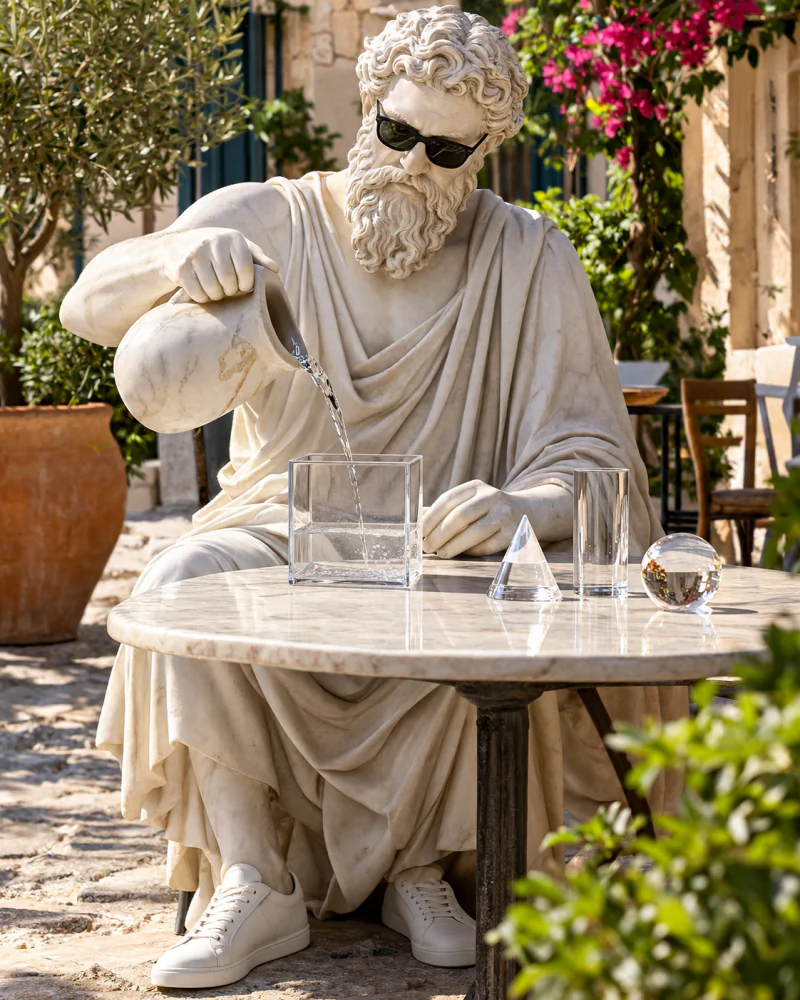
Volume is how much fits inside a solid; surface area is how much wrapping paper covers it. Most solids follow one pattern, base area × height, and the pointed ones take a third of that.
Volume = base area × height
For a box, a cylinder or any shape that has the same outline at every height, the volume is the area of the base times the height. Cones and pyramids, which come to a point, hold exactly one third of that.
Volume or surface area?
“How much does it hold,” “fill,” “capacity” mean volume, in cubic units. “Paint,” “wrap,” “cover the outside” mean surface area, in square units.
How to solve them
-
1
Boxes and cubes
A box has six rectangular faces in three matching pairs; a cube has six equal squares. In the formulas, l = length, w = width, h = height, s = the side of a cube, and SA means surface area: the area of all the faces added up.
BoxV = l × w × hSA = 2(l×w + l×h + w×h)CubeV = s³SA = 6s²Next step: CylindersExampleThe 8 × 5 × 4 box: what is its surface area?
- Faces: 8 × 5 = 40, 8 × 4 = 32 and 5 × 4 = 20, two of each.
- 2 × (40 + 32 + 20) = 2 × 92 = 184.
Answer 184 square inches
-
2
Cylinders: a circle times the height
The base of a cylinder is a circle, so its area is πr². Multiply by the height.
V = πr²h
Next step: Cones & pyramidsExampleA can has radius 5 and height 6. What is its volume?
- Square the radius first: 5² = 5 × 5 = 25, so the base is 25π.
- V = 25π × 6 = 150π. Keep π as a letter; it is about 471 with π ≈ 3.14.
Answer 150π
-
3
Cones and pyramids: one third of the matching solid
A cone holds one third of the cylinder with the same base and height; a pyramid holds one third of the box (or other straight-up solid) with the same base and height.
ConeV = ⅓πr²h⅓ of a cylinderPyramidV = ⅓ × base × h⅓ of a boxNext step: SpheresConeRadius 5, height 6
⅓ × 150π = 50π
Square pyramidBase 6 × 6, height 5
⅓ × 36 × 5 = 60
-
4
Spheres
A sphere has its own formula. Cube the radius first, then multiply by 4/3 and by π.
V = ⁴⁄₃πr³
Next step: Cubic unitsExampleA ball has radius 3. What is its volume?
- The radius is 3, so r³ = 3 × 3 × 3 = 27.
- Times 4/3: a third of 27 is 9, and 4 × 9 = 36. So V = 36π.
Answer 36π
-
5
Cubic units convert cubed
One foot is 12 inches, but one cubic foot is 12 × 12 × 12 = 1,728 cubic inches. One cubic yard is 3 × 3 × 3 = 27 cubic feet.
Next step: Doubling1 cubic yardin cubic feet
3 × 3 × 3 = 27
1 cubic footin cubic inches
12 × 12 × 12 = 1,728
-
6
Double every length: eight times the volume
Multiplying every length by 2 multiplies the surface area by 2 × 2 = 4 and the volume by 2 × 2 × 2 = 8.
Next step: Three examplesCube, side 2V = 8, SA = 24
Starting point
Cube, side 4V = 64, SA = 96
Volume × 8, surface × 4
-
7
Three worked examples, from easy to test level
Each one starts with a first try many people make, crossed out, and then the way that works. Read the wrong try too: it is the kind of answer the test puts in the choices.
The test-level one uses two solids. Find the volume of each one on its own, write it down, and only then compare them.
Example · EasyA cube-shaped crate has edges of 7 feet. How much does it hold?
First try
7 × 7 = 49 cubic feet- 49 is only one layer. The bottom of the crate fits 7 × 7 = 49 blocks of 1 cubic foot, and the crate is 7 feet tall, so it holds 7 layers.
- Volume of a cube: s³ = 7 × 7 × 7, which is 49 × 7.
- Without a calculator: 50 × 7 = 350, and take away one 7: 350 − 7 = 343.
Answer 343 cubic feet
Example · MediumA wooden crate is 12 inches long, 10 inches wide and 5 inches tall. How much cardboard covers the whole outside?
First try
12 × 10 × 5 = 600 square inches- “Covers the outside” means surface area, not volume. 600 is how much fits inside.
- The three different faces: 12 × 10 = 120 (top), 12 × 5 = 60 (front) and 10 × 5 = 50 (side).
- Each face has a twin on the other side. 120 + 60 + 50 = 230, and 2 × 230 = 460.
Answer 460 square inches
Example · Test levelA water cooler at the motor pool is a cylinder with a radius of 4 inches and a height of 9 inches. Each paper cup is a cone with a radius of 2 inches and a height of 6 inches. How many cups can a full cooler fill?
First try
Cup: π × 2² × 6 = 24π, so 144π ÷ 24π = 6 cups- Cooler (a cylinder): π × 4² × 9 = π × 16 × 9 = 144π.
- Cup (a cone): π × 2² × 6 = 24π is the cylinder around it. A cone holds a third of that: 24 ÷ 3 = 8, so 8π. The first try forgot the ⅓.
- Cups: 144π ÷ 8π. The π cancels, and 144 ÷ 8 = 18.
Answer 18 cups
4 traps in the answer choices
The test writes its wrong answers on purpose: each one is what you get if you make one of these mistakes.
Squaring instead of cubing
A cube with side 4, volume:
Wrong4² = 16
Right4³ = 64
Forgetting the ⅓ of a cone
A cone with radius 3 and height 8:
Wrong9π × 8 = 72π
Right⅓ × 72π = 24π
The diameter as the radius
A cylinder with diameter 10 and height 3:
Wrong100π × 3 = 300π
Right25π × 3 = 75π
Cubic units converted like plain units
4 cubic yards in cubic feet:
Wrong4 × 3 = 12
Right4 × 27 = 108
Try 2 questions
Two sample questions on this topic. Pick an answer, then read why. All the practice for this topic is in the Study Hall.
On the computer test, Mathematics Knowledge has 15 questions that count toward your score, in 31 minutes: about 2 minutes each. On paper it is 25 questions in 24 minutes, a little under 1 minute each. Volume questions are usually short: a box, a cylinder, a cone or a sphere with its measures, and you find how much it holds. Some ask for the surface area instead, or for a change of units.
No calculator. If the choices contain π, keep π as a letter: radius 4 and height 9 give 4 × 4 × 9, which is 144, so the answer is 144π. If the choices are decimals, use the value of π given in the question (like 3.14), and multiply the whole numbers first and π last.
Before you choose, read the question word again: “holds” or “fill” means cubic units, “paint” or “cover” means square units. On the computer test you cannot go back to a question, so check the formula once before you pick.
A box is 9 cm long, 4 cm wide and 5 cm tall. What is its volume?
Show the answer
C. Volume is length × width × height: 9 × 4 = 36, and 36 × 5 = 180. 202 is the surface area, 2 × (36 + 45 + 20). 101 adds the three faces only once, and 18 adds the three edges. The volume is 180 cubic cm.
A cube has edges of 5 inches. What is its surface area?
Show the answer
D. A cube has 6 square faces, each 5 × 5 = 25. Six of them: 6 × 25 = 150. 125 is the volume, 5 × 5 × 5. 100 counts only the 4 sides and forgets the top and bottom, and 25 is a single face. The surface area is 150 square inches.
Practice this topic for real
The full lesson in the ASVABIFY Community: more practice questions with every answer explained, and a checkpoint that tells you when you have it. Reading is free with an account; all the practice comes with Study Hall Plus, and it is included with Pro.
Practice in the Study Hall Stuck on one? Ask in #questions, free12 flashcards
Tap a card to flip it. Keep the ones you miss until they stick.
All 12 cards known.
You finished this lesson: Volume and surface area.
Practice score: not taken yet Take the practice
Next topic: Composite figures Course mapSee this topic move.
In the course, every topic is drawn step by step on a whiteboard while a voice explains it, with timed practice tests and a plan for your test date. The first lessons of every module are free.