Learn›Mathematics KnowledgeMK›Probability
Probability and counting
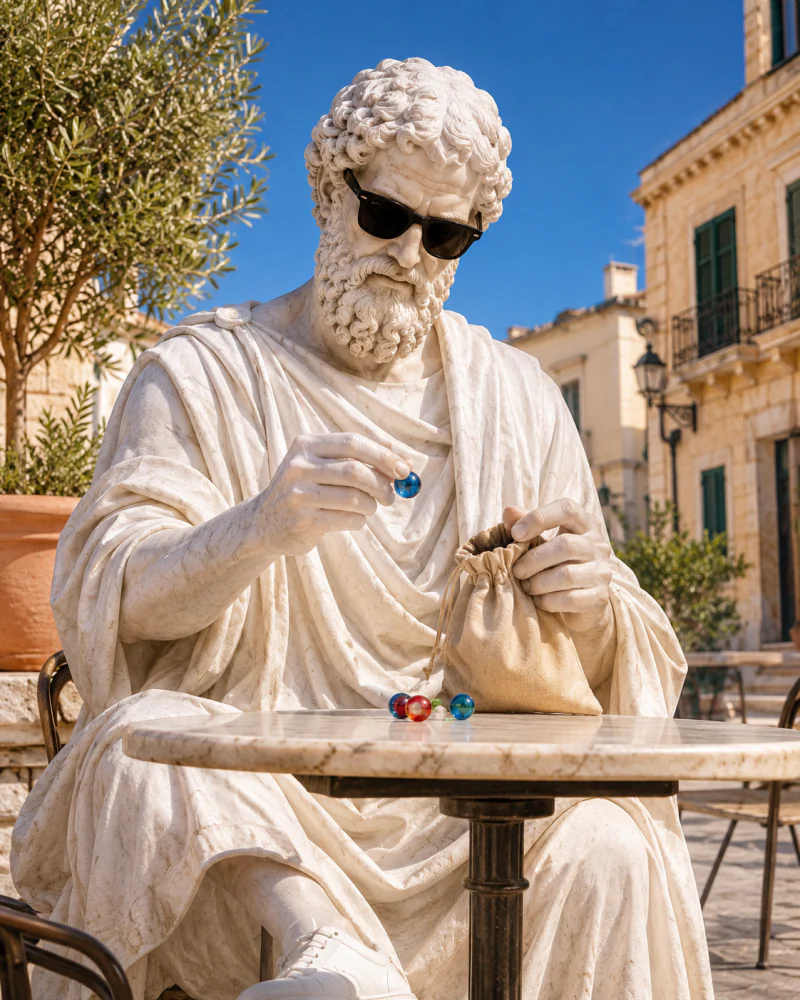
Marbles in a bag, a card from a deck, a lock code, a line of people: probability and counting questions look different, but they use a handful of moves. Count carefully, then add, subtract from 1 or multiply. This page shows which one, and when.
Probability: the ways you want over all the ways
probability = favorable ÷ total
Probability is a number that says how likely something is. Each possible result is an outcome: here, each of the 10 tickets. The results you are asking about are the favorable outcomes: the 3 winning tickets. When every outcome is equally likely, the probability is the favorable outcomes divided by all the outcomes. You can write it as a fraction, a decimal or a percent: all three say the same thing.
Always between 0 and 1
A probability of 0 means it cannot happen, like rolling a 7 on a normal die. A probability of 1 means it is certain, like rolling a number under 7. Everything else sits in between. So a choice bigger than 1, like 5/4 or 120%, is always wrong: cross it out first.
How to solve them
-
1
Count the ways you want, then count all the ways
Two counts, then one division. First count the favorable outcomes: the ones the question asks about. Then count the total: every outcome, the favorable ones included. The total is the whole group, never just “the others”.
A die (plural: dice) is a cube with the numbers 1 to 6 on its faces. A standard deck has 52 cards: 4 suits (hearts, diamonds, clubs, spades) of 13 cards each. Each suit has an ace, the numbers 2 to 10, a jack, a queen and a king, so there are 4 of each value: 4 aces, 4 kings, and so on. Hearts and diamonds are red; clubs and spades are black.
P(green) is short for “the probability of green”. So P(green) = green ÷ all marbles.
- P(green) = green ÷ all marbles
- 6 ÷ (6 + 9)
- 6 ÷ 15
- 2/5
- 0.4 = 40%
A jar with 6 green and 9 yellow marbles. The total is 15, not 9. Next step: NotOne dieProbability of rolling a 6
1 favorable face out of 6: 1/6
A deckProbability of drawing a red card
26 red cards out of 52: 26/52 = 1/2
A jarProbability of drawing a yellow marble from the jar
9 out of 15: 9/15 = 3/5
ShortcutSimplify at the end
Answer choices are usually fractions in lowest terms. Write favorable over total first, then divide the top and bottom by the same number: 26/52 becomes 1/2 when you divide both by 26.
-
2
The chance it does NOT happen: 1 minus
P(not A) = 1 − P(A)
Something either happens or it does not, so the two probabilities add up to 1, or 100%. This “does not happen” event is called the complement. When the question says not, find the easy probability and subtract it from 1.
A forecast says there is a 20% chance of rain. The chance of no rain is 100% − 20% = 80%.
Next step: And: multiplyExampleA spinner has 8 equal parts, and 3 are red. What is the probability of NOT landing on red?
- The probability of red is 3 out of 8: 3/8.
- Not red is everything else: 1 − 3/8.
- Write 1 as 8/8, so 8/8 − 3/8 = 5/8.
- Check by counting: 8 − 3 = 5 parts are not red, out of 8.
Answer 5/8
- P(not red)
- 1 − 3/8
- 8/8 − 3/8
- 5/8
-
3
Two independent events: multiply
Two events are independent when one does not change the chances of the other. A coin and a die are independent: the coin has no idea what the die did. For the probability that both happen, multiply.
P(A and B) = P(A) × P(B)
A coin and a die: all the outcomes1 2 3 4 5 6 Heads H1 H2 H3 H4 H5 H6 Tails T1 T2 T3 T4 T5 T6 There are 2 × 6 = 12 outcomes, and only one of them is heads and a 6. That is why multiplying works.
Next step: Put back or not- P(heads and 6)
- 1/2 × 1/6
- 1/12
One box out of the 12 in the table. ExampleEach day, one name is picked at random from the same 8 names for kitchen duty. What is the probability that Diaz is picked on both Monday and Tuesday?
- Monday: 1 name out of 8, so 1/8.
- Tuesday is a new pick from the same 8 names: 1/8 again.
- Both days: 1/8 × 1/8 = 1/64. “And” makes the chance smaller.
Answer 1/64
-
4
With and without replacement
When you draw twice from the same bag, ask: does the first item go back in? With replacement means you put it back, so the second draw looks exactly like the first. Without replacement means you keep it, so the second draw has one fewer item in all, and one fewer of the kind you took.
Words that mean without replacement: “does not put it back”, “keeps the first one”, “two at once”, or picking two different people. “One after the other” alone does not tell you: look for whether the first item goes back.
Next step: Counting- P(lemon, then lemon), put back
- 4/10 × 4/10
- 16/100
- 4/25
A jar of 4 lemon and 6 cherry candies. Put back: the jar is the same for the second pick. - P(lemon, then lemon), not put back
- 4/10 × 3/9
- 12/90
- 2/15
Not put back: one lemon fewer (3) and one candy fewer (9). -
5
Counting choices: multiply the options
The multiplication principle: if you make one choice and then another, the number of ways is the number of options for the first times the number of options for the second. With three choices, multiply all three.
Think of slots. Draw one blank for each choice, write how many options fit in each blank, and multiply. For codes, ask if a digit or letter can repeat. There are 10 digits (0 to 9) and 26 letters (A to Z).
- 3 shirts × 4 pants × 3 caps
- 12 × 3
- 36 outfits
Every shirt goes with every pair of pants, and every pair goes with every cap. Next step: ArrangementsA PIN4 digits, repeats allowed
10 × 10 × 10 × 10 = 10,000
Letter, then digitA code like B7
26 × 10 = 260
Meal deal5 mains and 4 drinks
5 × 4 = 20 meals
Shortcut“And then” means multiply
Adding the options (3 + 4 + 3 = 10) counts single items, not outfits. If each choice comes with every other choice, multiply.
-
6
Arrangements: the choices shrink by one
An arrangement (also called a permutation) is a way to put things in order. The slot idea still works, with one change: once a person or object is used, it cannot be used again. So each slot has one option fewer than the slot before.
Five people stand in a line for a photo. Any of the 5 can stand first. Then 4 are left for second place, 3 for third, 2 for fourth, and the last person takes the last spot.
- 5 × 4 × 3 × 2 × 1
- 20 × 3 × 2 × 1
- 60 × 2 × 1
- 120 ways
Multiply from the left, one piece at a time. Next step: Three examplesFirst and second place8 runners in a race
8 × 7 = 56 ways
Three lettersWays to order the letters of CAT
3 × 2 × 1 = 6: CAT, CTA, ACT, ATC, TCA, TAC
ShortcutThe factorial sign
5! (read “5 factorial”) means 5 × 4 × 3 × 2 × 1 = 120. When the question only fills some places, stop early: first and second place out of 8 is just 8 × 7.
-
7
Three worked examples, from easy to test level
Each one starts with the first try many people make, crossed out, and then the way that works. Read the wrong try too: it is the kind of answer the test puts in the choices.
The test-level one draws two names without putting the first back. Change the fraction for the second draw before you multiply: one fewer of the kind you took, and one fewer in all.
Example · EasyA box has 5 chocolate bars, 9 granola bars and 6 protein bars. You grab one without looking. What is the probability it is a granola bar?
First try
9 granola bars against 11 others: 9/11- 9/11 compares granola with the other bars. The bottom of the fraction must be all the bars, granola included.
- Total: 5 + 9 + 6 = 20 bars.
- Favorable: the 9 granola bars.
- Probability: 9/20, which is 45/100 = 0.45 = 45%.
Answer 9/20 (45%)
Example · MediumA base gate uses a 4-digit code. The first digit cannot be 0, and digits can repeat. How many codes are possible?
First try
9 + 10 + 10 + 10 = 39- Adding counts the digits you could press, not the codes. Every first digit goes with every second digit, so multiply.
- Four slots. The first has 9 options (1 to 9). Each of the other three has 10 options (0 to 9).
- 9 × 10 × 10 × 10: the three 10s make 1,000.
- 9 × 1,000 = 9,000.
Answer 9,000 codes
Example · Test levelA hat holds the names of 3 sergeants and 5 privates. Two names are drawn, one after the other, and the first name is not put back. What is the probability that both are sergeants?
First try
3/8 × 3/8 = 9/64- The first try uses 3/8 twice, as if the first name went back in the hat. It did not.
- First draw: 3 sergeants out of 3 + 5 = 8 names, so 3/8.
- If a sergeant came out, 2 sergeants are left, out of 7 names: 2/7.
- Both: 3/8 × 2/7 = 6/56. Divide the top and bottom by 2: 3/28.
Answer 3/28
4 traps in the answer choices
The test writes its wrong answers on purpose: each one is what you get if you make one of these mistakes.
Part over part
A bag has 3 red chips and 9 blue chips. The probability of red:
Wrong3/9 = 1/3
Right3/12 = 1/4
Adding when it says “and”
Rolling a 5 on one die and a 5 on a second die:
Wrong1/6 + 1/6 = 1/3
Right1/6 × 1/6 = 1/36
Forgetting the first card is gone
Two cards from a deck, without replacement. Both aces:
Wrong4/52 × 4/52 = 1/169
Right4/52 × 3/51 = 1/221
Adding the choices
5 caps and 6 T-shirts. How many outfits?
Wrong5 + 6 = 11
Right5 × 6 = 30
Try 2 questions
Two sample questions on this topic. Pick an answer, then read why. All the practice for this topic is in the Study Hall.
Probability and counting questions show up in Mathematics Knowledge, and sometimes as word problems in Arithmetic Reasoning: marbles in a bag, cards, dice, codes, schedules. On the computer test, Mathematics Knowledge has 15 questions in 31 minutes, about 2 min 4 s each. On paper it is 25 questions in 24 minutes, about 58 s each.
No calculator. Keep the fractions as fractions and simplify at the end, because the choices are usually written in lowest terms. Before you calculate, cross out any choice bigger than 1 or above 100%: no probability can be.
A tip: look for the key words. “Not” means subtract from 1. “And” or “both” means multiply. “Not put back” means the second fraction shrinks. On the computer test you cannot go back to a question, so decide which rule fits before you start.
A cup holds 7 blue pens and 13 black pens. One pen is picked at random. What is the probability that it is blue?
Show the answer
B. Favorable: the 7 blue pens. Total: all the pens, 7 + 13 = 20. So the probability is 7/20. 7/13 divides by the black pens only, 13/20 is the chance of black, and 1/20 counts one blue pen instead of seven. The answer is 7/20.
The probability that a bus arrives late is 0.15. What is the probability that it does NOT arrive late?
Show the answer
B. Late and not late add up to 1, so subtract: 1 − 0.15 = 0.85. Think in cents: 100 − 15 = 85. 1.15 adds instead of subtracting and is bigger than 1, which is impossible. 0.95 takes away only the 5 hundredths. The answer is 0.85.
Practice this topic for real
The full lesson in the ASVABIFY Community: more practice questions with every answer explained, and a checkpoint that tells you when you have it. Reading is free with an account; all the practice comes with Study Hall Plus, and it is included with Pro.
Practice in the Study Hall Stuck on one? Ask in #questions, free12 flashcards
Tap a card to flip it. Keep the ones you miss until they stick.
All 12 cards known.
You finished this lesson: Probability and counting.
Practice score: not taken yet Take the practice
End of Mathematics Knowledge. Take the part test Course mapSee this topic move.
In the course, every topic is drawn step by step on a whiteboard while a voice explains it, with timed practice tests and a plan for your test date. The first lessons of every module are free.